Why STEM Matters: How Programming and Robotics Help Children Learn
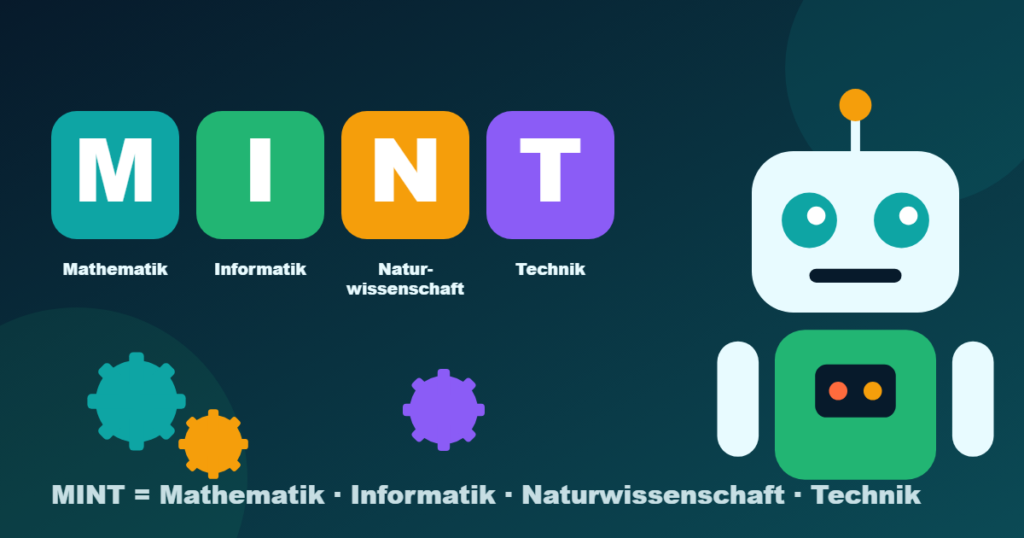
MINT is the German term for STEM: mathematics, informatics, natural science and technology. What children actually practise when they code and build robots, what the research says and what it does not.
By MINT-SmartLab Graz · Updated on 12 November 2026
Children grow up with technology – tablets, smartphones, traffic lights, elevators, robot vacuum cleaners. The key question is whether they only use or also understand. That is exactly where STEM comes in. In German it is called MINT, which stands for Mathematics, Informatics, Natural science and Technology. In this article we explain what children actually practise when they code and build robots, what research says about it and what it does not say.
What programming actually trains
Anyone who wants to teach a robot or a computer something has to understand the problem first. The technical term for this is computational thinking. It consists of four building blocks:
- Decomposition: A big task is divided into small steps. “The robot should drive to the wall and turn around” becomes: drive forward, check the distance, stop, turn.
- Pattern recognition: Does something repeat? Then one loop is enough instead of ten identical commands.
- Abstraction: Children recognise what matters (the distance) and what does not (the colour of the carpet).
- Algorithms: A precise sequence of instructions that someone (or something) can carry out without asking questions.
What the research says
It is often claimed that programming promotes thinking. The question is what can be proven. A review published in 2024 in the journal Computers & Education (Montuori and colleagues) analysed 19 studies with children and teenagers between 4 and 16 years old. The statistical meta-analysis included 11 studies with 862 participants. The results at a glance:
| Skill | Effect |
|---|---|
| Problem solving | large (d = 0.89) |
| Planning | small to medium (d = 0.36) |
| Working memory | small (d = 0.20) |
| Inhibition (holding back impulses) | small (d = 0.17) |
| Cognitive flexibility | no clear effect |
One finding from the same paper matches our practice: with younger children, guided, structured activities with robots or visual programming seem to work well, while older students tend to do better with open projects.

How this can help in everyday school life
- Mathematics becomes applicable: Numbers, angles (how far does the robot turn?), repetitions and comparisons (“is the distance less than 20 cm?”) produce something visible.
- Precise wording: A computer does not understand vague instructions. Children learn to describe precisely what they mean. This also helps when writing instructions or solving word problems.
- A culture of making mistakes: In programming, an error is a hint, not a failure. Children who experience that searching and improving leads to the goal stay with difficult tasks for longer.
- Teamwork: In our courses, two children work on each kit. They have to agree, divide tasks and explain their result.
From 6 to 16: what our courses actually do
Children learn STEM differently at every age. Our courses build on each other:
| Course | Age | What the children do |
|---|---|---|
| Robotics | 6–8 | Build robots and control them with code blocks: drive, light up, sounds, sensors |
| micro:bit | 8–10 | Program mini computers with LEDs and sensors: dice, step counter, alarm system |
| Electronics with Arduino | 10+ | Build circuits, control LEDs and motors with the Arduino |
| 3D design & printing | 11+ | Design and print your own objects |
| Drones | 12+ | Drone master class for teenagers |
You can read more about the first two levels in our articles Robo Wunderkind and What is Arduino?.
What parents can do
- Ask: “Show me what your robot can do.” Explaining reinforces what has been learned.
- Do not solve errors for the child. Instead ask: “What did you expect, and what happened?”
- Praise the trying out, not just the result.
Would you like to know which course suits your child or your school? We offer free advice.
Frequently asked questions
What does MINT mean?
MINT is the German acronym for mathematics, informatics, natural science and technology. In English it is called STEM.
Does programming improve school grades?
The studies reviewed mainly show effects on problem solving and planning. It has not been shown that grades automatically rise as a result.
From what age does STEM education make sense?
Starting is possible as early as primary school age. Our robotics course is aimed at children from 6 to 8 years old, with no prior knowledge needed.
Source: Montuori, C., Gambarota, F., Altoé, G., Arfé, B. (2024). The cognitive effects of computational thinking: A systematic review and meta-analytic study. Computers & Education, 210, 104961.
Bring this course to your school?
We bring our courses to schools and after-school care in Graz. Write to us for a no-obligation offer.