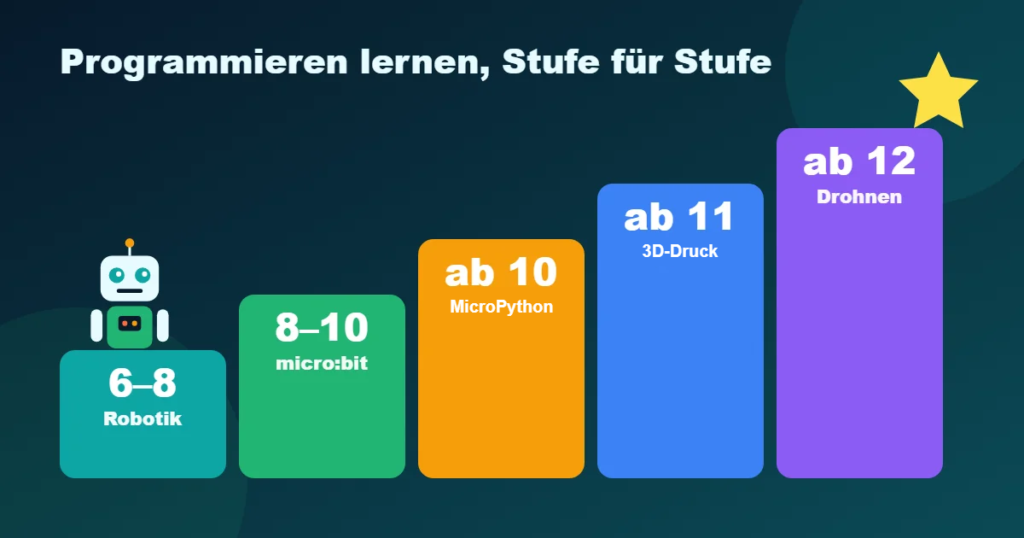
What matters at each age

6 to 8 years: programming with building blocks

At this age, children learn best when they can touch something. With a robotics kit they snap modules together and use colorful code blocks to decide what the robot does. Reading and writing are not needed for this. What matters is that the result is visible immediately: the robot drives, blinks or makes a sound. This is how children experience cause and effect. Our Robotics course with Robo Wunderkind is made for exactly this.

8 to 10 years: from blocks to a mini computer

From around age eight, children can plan several steps. The micro:bit is a small computer with 25 LEDs, buttons and sensors. Children program it with blocks and build their own projects such as a digital die or a step counter. Along the way they learn conditions and loops without worrying about typing errors. More in the micro:bit course.

From age 10: real code and electronics

Ten-year-olds are usually ready for text code. In the Electronics course they build circuits and program the Arduino Nano ESP32 with MicroPython. The language is easy to read, and the children immediately see what their code does on real hardware.

From age 11: 3D design and 3D printing

Anyone who thinks spatially can design their own objects on the computer and print them with a 3D printer: key rings, figures or buildings. The 3D printing course combines digital construction with patience and precision and requires no prior knowledge.

From age 12: understanding technology from the ground up

Teens can follow complex tasks over many weeks. In the Drone Master Course they build a drone themselves: soldering, wiring, programming, calibrating and flying.

Which level fits depends less on the date of birth than on experience. A child without prior knowledge is best off starting at the level that matches their age. All courses are available at schools and in after-school care in Graz.

Home › Blog › Guides

At what age can children learn to program?

The good news: earlier than many think, and without prior knowledge. What matters is that the method fits the age.

GuideBy age group
@Staircase of courses by age: robotics, micro:bit, electronics & MicroPython, 3D printing and drones
The right start depends on age: from robotics to the drone.

What matters

Children learn best hands-on, in small groups and with quick successes. Mistakes are part of it: whoever tries things out, learns. No prior knowledge is needed. You can find an overview of all courses in our course overview.

Which course fits?

Write to us with age and prior experience and we will recommend the right course. Also for schools and after-school care.